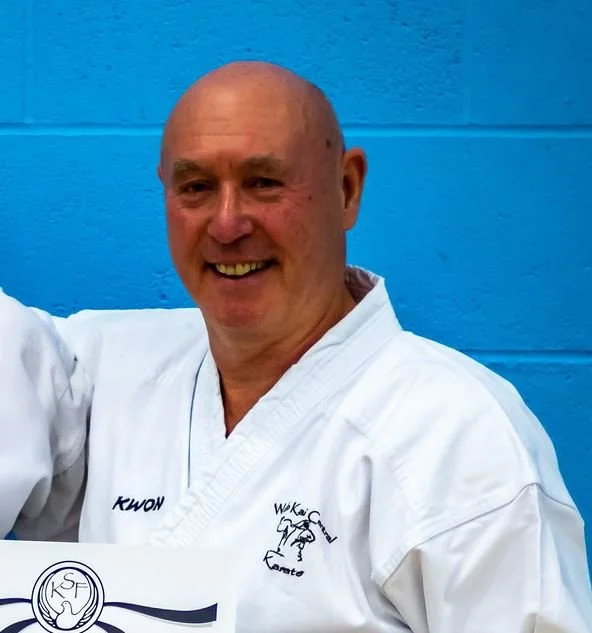
Charlie Lindsay 8th Dan
Technical Committee

Hamish Adam 9th Dan MBE
Head of the Technical Committee

Paul Connor 6th Dan
Technical Committee
“Every movement in karate is performed with the whole body; never with the four limbs”
Hironori Ohtsuka
(founder of Wado-Ryu karate)
-

Senior Dan Grade
A Senior Dan Grade in Karate signifies advanced mastery, experience, and leadership. Typically awarded from 4th Dan and above, it reflects not only high technical skill in kihon, kata, and kumite, but also strong discipline, character, and dedication.
Senior Dan practitioners serve as instructors and role models, guiding others while continuing their own development. This rank recognises both ability and the commitment to uphold and share the values of karate.
-
Dan Grade
Achieving a black belt represents a significant milestone in a student’s training. It demonstrates a strong understanding of fundamental techniques, discipline, and dedication to the art. A black belt is not the end of the journey, but the beginning of deeper learning, leadership, and continued personal development within karate.
-

1st Kyu
The final stage of coloured belt training before black belt. Students demonstrate advanced technical skill, strong discipline, and a deep understanding of karate principles. Training focuses on refining techniques, improving speed, power, balance, and precision, while building confidence in kata, kumite, and self-defence. Students are expected to show leadership within the dojo as they prepare for the challenge of Shodan.
-
2nd Kyu
2nd Kyu marks an advanced stage in a student’s karate development. Practitioners refine their techniques with greater speed, control, and precision while strengthening their understanding of kata, kumite, and practical self-defence. Training places strong emphasis on consistency, discipline, and the application of techniques under pressure. Students are encouraged to demonstrate maturity and commitment within the dojo.
-
3rd Kyu
3rd Kyu represents the beginning of the advanced stages of karate training. Students build upon strong fundamentals while developing greater power, control, and technical accuracy. Training focuses on improving kata performance, sparring ability, and the practical application of techniques. Students are expected to demonstrate increased discipline, confidence, and commitment as they continue progressing toward higher levels of skill and responsibility within the dojo.
-

4th Kyu
4th Kyu marks an important stage in a student’s development as they move into more advanced training. Students focus on strengthening their fundamentals while improving technique, coordination, and control. Training emphasises the development of more complex kata, stronger sparring skills, and a deeper understanding of karate principles. Students are expected to show growing confidence, discipline, and commitment as they continue progressing through the Kyu grades.
-

5th Kyu
5th Kyu represents a significant step in a student’s karate journey as they move beyond the beginner stages. Students continue to strengthen their fundamental techniques while developing improved coordination, balance, and control. Training focuses on refining basic movements, advancing kata performance, and building confidence in sparring and practical application. Students are encouraged to demonstrate dedication, discipline, and a strong foundation.
-

6th Kyu
4th Kyu represents the stage in a student’s karate development as they continue progressing beyond the beginner levels. Students build stronger technical foundations while improving coordination, balance, and control. Training focuses on refining fundamental techniques, developing more advanced kata, and increasing confidence in sparring and practical application.
-

7th Kyu
7th Kyu is a stage in a student’s early karate development. Students begin building greater confidence in their fundamental techniques while improving coordination, balance, and timing. Training focuses on strengthening basic stances, strikes, blocks, and introductory kata, while introducing controlled sparring and practical application. Students are encouraged to develop discipline, focus, and a positive training attitude.
-

8th Kyu
8th Kyu represents an early stage in a student’s karate journey where the focus is on developing strong fundamentals. Students begin to build confidence in basic stances, blocks, strikes, and simple combinations. Training emphasises coordination, balance, and proper technique, while introducing the first kata and basic partner work. At this level, students develop discipline, focus, and a solid foundation.